Saturday, 1 May 2010

Sun 25th April 2010 - Leg11a : Broxbourne to Hertford - 12.5 miles

It was a good turn-out with Sandra Scott, Jonathan & Linda Berks, Barbara & Peter Mitton, Howard and Fudge Peacock, Ray Munden and David Izod lulled into a false sense that the weather would be fine following the brilliant day that we had enjoyed on Saturday. Surprise, surprise it rained!


Most of the walk was along the New River, which continues to be a major supply of water into London, and the River Lea Navigation with a brief diversion into the Ash Valley to get the obligatory mileage in. We started at Broxbourne Station and after a couple of miles reached Rye House Station, close to the scene of The Rye House Plot of 1683 which was a plan to assassinate King Charles II of England and his brother (and heir to the throne) James, Duke of York, builder of Peter Franks’ palace. Historians vary in their assessment of the degree to which details of the conspiracy were finalized. Anti-Catholic sentiment, which associated Catholicism with absolutism, was widespread, and focused particular attention on the succession to the throne. While Charles was publicly Anglican, he and his brother were known to have Catholic sympathies. These suspicions were confirmed in 1673 when James was discovered to have converted to Catholicism. Rye House, a manor house owned by a well-known Republican, Richard Rumbold was to conceal a force of 100 men in the grounds and ambush the King and the Duke on their way back to London from the horse races at Newmarket. However, because there was a great fire in Newmarket on 22 March, which destroyed half the town, the races were cancelled, and the King and the Duke returned to London early. As a result, the planned attack never took place. Historians have suggested the story of the plot may have been largely manufactured by Charles or his supporters to allow the removal of most of his strongest political opponents. Politics always was a rough old trade.

At Stanstead Abotts we passed the Clock House. From 1635 it housed a grammar school founded by Sir Edward Baesh, which subsequently closed in 1881 and is now a residential property. The town is also famous for fishing and was recommended by Izaak Walton in his book, “The Complete Angler”.

We walked up the Ash Valley, back through Easneye Wood, along the disused railway line to Buntingford, axed by Dr Beeching in 1965 and back to the sand and gravel pits at Amwell. In doing so we managed to lose our ladies who had stopped to take pictures of the wildlife conservation area and got left behind. Whilst searching for them, Howard found a sign post saying Hertford 2 1/4 miles, but of course the planners had other routes in mind for us, giving us well over 5 miles further to walk!

After being reunited we continued on across the railway and the New River to the church of St John’s built in the 11th century and much restored. Peter and Jonathan were confined to the stocks there but we were too polite to throw rotten eggs at them! We enjoyed a well earned pint at the George IV pub. Stirring our stumps we passed by the monument to Sir Hugh Myddleton, builder of the New River near to Emma’s Well close to one of the springs that feeds the New River.

Continuing along the New River and the Lee Navigation tow path we eventually turned up at Ware passing by the Gazebos. These were erected by the Ware inns to attract new trade following the setting up of England’s first turnpike road which then as now caused all the traffic to find an alternative free route and had had a disastrous effect on their business!

I had not realized how interesting Ware and later when we got there, Hertford, are. We tend only to see the main street and miss all the older nooks and crannies. Anyway, somewhat footsore but pleased with our accomplishment we finished our walk at around 4 pm in a nice, pleasant afternoon at Parliament Square.

Sat 24th April 2010 - Leg 10a : Cuffley to Broxbourne - 12 miles

It was a gloriously sunny morning as we, David Izod, Jim Webb, Chris Hardy, Ray Munden, Sandra Scott, Guy Garfit and Jinny and our guides from the Friends of the Hertfordshire Way, Peter and Sue Garside, left Cuffley Station at 9.30am to retrace part of our earlier walk from Shenley to Cuffley on our way to Goffs Oak. Goffs Oak is named after the Goff Family who were for many years the major land owners in the area until the last one of the line past away in the mid 20th century. The old oak reputed to be several hundred years old of Goff fame also met its demise in 1950’s and its replacement lasted until 1987 when it was destroyed by the October gales. The current oak proudly stands outside the Goff Oak pub. One of the village’s claims to fame is that Victoria Beckham, one of the Spice Girls pop group, once lived there.
On leaving Gaffs Oak we quickly left suburbia behind to be heralded by multitudinous clouds of blackthorn blossom, wherever you looked, until we reached Broxbourne Woods. It looks as if it’s going to be a bumper sloe crop this year provided we avoid any more frosts.

On leaving Tanfield Stud we entered a series of four woods namely Wormley Wood, Bencroft Wood, Hoddeston Park Wood and Broxbourne Wood which form the Broxbourne Woods National Nature Reserve (NNR). These are also recognised as Sites of Special Scientific Interest as they are home to some of our scarce woodland wildlife. One of our rarest butterflies, the Purple Emperor, has found a home in Broxbourne Wood. The woods also have a strong connection with the past evidenced by the banks and ditches in and around the woodlands which tell us our Roman and Medieval ancestors once coppiced the woodland for fuel and had pastures for livestock.

The woodland is a mixture of hornbeam and sessile oak. In fact they are the most northerly natural occurring hornbeam woods in the country although you will find hornbeam garden hedges much further north. Hornbeam is a wood that is heavy and hard and is often referred to as iron wood. It is used for tools and for construction purposes, for example it has been used as spokes in wheels, gear pegs in geared drive wheels in windmills, pianos, parquet flooring etc. where hardness and good wearing requirements are of paramount importance. The wood also burns hot and slowly making it very suitable for firewood and charcoal. The latter uses were the saving of Epping Forest where the hornbeam is the favoured pollarding tree. Sessile or Welsh Oak, as it is the national tree of Wales, is taller and straighter than English Oak and because of this is particularly suitable for the construction of oak framed buildings. It gets is name from the fact that the acorns grow straight from the stem, the sessile, where in the case of the English Oak they grow on stalks.

The woods, that are thought to go back to the ice age, were first mentioned in documents in the 6th Century in relation to Ermine Street which passes through Wormley Wood. Undoubtedly Harold would have passed through the wood in 1066 on his way to challenge William of Normandy at Hastings. Gradually, this like all Roman roads was allowed to deteriorate. The fact that they were still used as drove roads until the 19th century speaks volumes for the road building abilities of our Roman ancestors.

On your way through the four mile stretch of woodland we passed a Coal Post. These were first erected around London in 1851 to denote where duty would be levied on imported coal and wine leaving the city. This tax goes back to1667 when it was levied to pay for the rebuilding of London following the Great Fire of 1666. In 1861 the 250 posts (44 in Hertfordshire) were moved to coincide with the new Metropolitan Police District. The City’s Wine and Coal Duty Act was repealed in 1892.

Within Broxbourne wood are areas of recently planted conifers which are gradually being removed to bring back native broadleaved trees. Unfortunately with the conifers will go the gold crests which you could hear chattering away in the tops of the trees as we passed by below.

In Hoddesdon Park Wood we passed a moated site thought to be the location of an ancient deer park-keepers lodge. No buildings have survived. It is a scheduled ancient monument probably dating back to the 13th century as a 1290 document details the restocking of the wood with two bucks and two does from the Forest of Essex. Wherever you looked the floor of the wood is a carpet of white wood-anemones. Coppicing has opened up the woods to sunlight allowing the flowers to flourish in the dappled light. Open glades are being formed to allow other plants to grow and attract butterflies and other wild life.

On leaving the wood we turned left for the Huntsman for a pint and a leisurely late lunch in the sunshine leaving us with a three mile stroll to Broxbourne for a 3.30 pm. finish. This village is the oldest recorded in the area. A mill is mentioned in the Domesday survey. The remains of the one found near the station built in the 19th century last ground corn in 1890 and burnt down in 1949 when it was being used as an engineering workshop. The last stretch of the walk was along New River, a 40 mile long aquifer of clear spring water built on the 100 foot contour line. It was built between 1608 and 1613 to take drinking water to London from Amwell and Chadwell springs. The area along the river was a hive of activity with two cricket matches and two football matches in progress and many families out enjoying the spring sunshine. A most enjoyable walk was enhanced by the interest and background supplied by our guides Sue and Peter Garside.

Many Thanks.

Jim Webb

Monday, 5 April 2010

Sun 21st March 2010 - Leg 10 : Cuffley to Hertford - 12.6 miles

At last it seemed that Spring was springing when the intrepid quartet of Sandra Scott, Howard Peacock, Fudge Peacock and David Izod set off on Leg 10 from Cuffley to Hertford. The blackthorn buds were finally breaking and the blossom developing almost in front of our eyes. For pretty much the first time we had warm, sunny and dry weather for our walk. Howard certainly knows how to pick the date as it was his first walk with us!

We left Cuffley Station and walked up Tolmers Road that Howard’s aunt had lived in some years ago. Originally, the houses had been built in the style of those in Letchworth Garden City. However, the developers had been at it since, with lots of lovely new houses with smart bricked drives, so Howard no longer recognised the place. We walked through woods that were part of Tolmers Park Estate. The Scout Association bought some of the estate in 1939 and many thousands of scouts use the area each year.

We encountered another example of the sadistic nature of the planners of the Hertfordshire Way at a place near to West End, about 5.5 miles into the walk. We went round in a loop of about ¾ mile to finish up at a turn that we had seen previously, about 50 yards up the path! To add insult to injury, The Candlestick pub had closed down at West End so we could not quench our thirst.

Pressing on, we passed through the village of Essenden, through another golf club, to emerge at Little Berkhamstead. The locals were holding a sponsored Sports Relief circular walk around their common and we were invited to join them. By this time our tongues were hanging out so we politely declined and made our way to the ancient Five Horseshoes pub (7.9 miles). Fudge enjoyed a quick afternoon siesta whilst we refuelled.

Resuming our perambulations we passed the lovely Little Berkhamstead Church, quickly followed by a folly built in 1789 by retired Admiral John Stratton as an observatory. Now, plodding on, we travelled through Bayford Wood, the village of Bayford and eventually along a track by the side of the railway. We ran into a couple of railway workers and a policeman who were at the scene of a crime. We were not told anything but it seemed to us that someone had nicked cable from the railway track. We did not have to empty our rucksacks to prove our innocence!

From here it was but a hop, skip and a jump to Parliament Square, Hertford (12.6 miles). No, I tell a fib – but how else are we to get more people on this grand adventure! At Parliament Square, we were able to relax and enjoy the afternoon sun for 15 minutes until Lesley turned up to carry us home. So Sandra has completed 120.7 miles whilst the rest of us have a little catching up to do.

Sat 20th March 2010 - Leg 9 : Shenley to Cuffley - 11.5 miles

Nine of us on this leg, David Izod, Lynda and Jonathan Berks, Liz Beardwell, Jim Webb, Guy Garfitt plus Ginny, Sandra Scott and yours truly (wearing the red hat!). David Beardwell had been due to join us but he wasn’t feeling well.


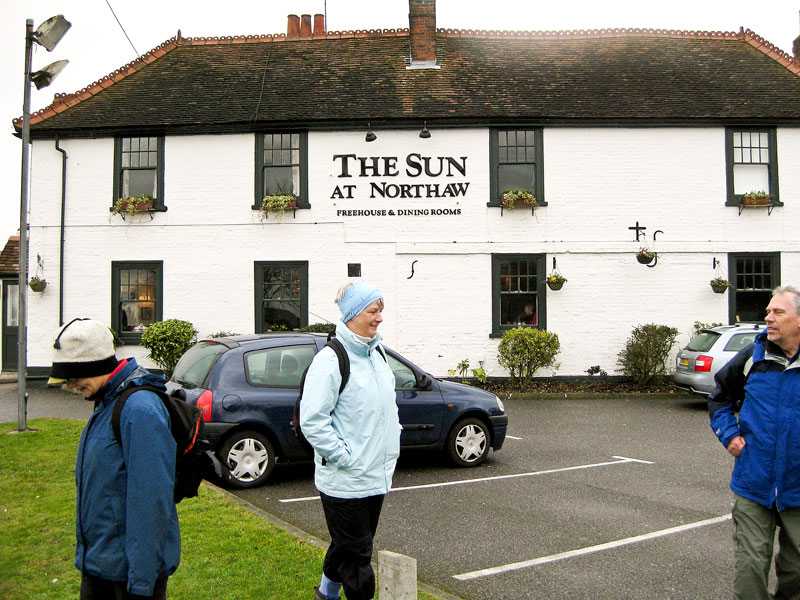
It was drizzling when we left Shenley Park and it was drizzling when we eventually reached Cuffley Station. For some reason, the gods looked down on us favourably when we reached The Sun at Northaw, the drizzle held back and we were able to eat our lunches in the pub garden and down a well earned pint.


As we left Shenley, someone shouted, “W. G. Grace used to play cricket over there” but we’d passed the gap in the hedge and missed it! The rain and mist hid the views across the Vale of St Albans so we missed seeing the Pastoral Centre, the tower of Napsbury Hospital and St Albans Abbey. We crossed a ploughed field which, mercifully, turned out to be less muddy and sticky than it looked.


Just over an hour into the walk we came to a monument at the bottom of someone’s garden. As you will see from the photo it is thought to have been erected by the Dudding family to celebrate their cousin, Admiral Nelson’s victory at Trafalgar. It also indicates that the Earl of Warwick’s death on the spot during the battle of Barnet in 1471 is probably a myth. Perhaps the monument was a figment of our imaginations! Immediately after the monument we entered a “kissing” gate which of course the Berks had to demonstrate.


We continued on to pass under the M25. Judging by the rubbish, the underpass looked as though it had been used by people sleeping rough. Shortly, we came to the village of South Mimms. Time for a break. Unfortunately the Black Horse pub was closed so refuge was sought at a picnic table in the children’s playground - it was just a pity about the rain. Refuelled, we set about finding the next part of our path. We found it hidden between two houses.


Our path took us along the side of the Catherine Bourne towards the A1(M). Another damp and dingy underpass and lots more rubbish. We walked on past Warrengate Farm and thence to the Cranbourne Industrial Estate and the railway line; through yet another underpass. More comments on the amount of rubbish to be seen in the bushes. After the railway, we crossed Potters Bar Golf Course following the course of a ditch. We pondered the existence of a pill-box in the middle of the course. The Golf Club’s website doesn’t say much about it other than during WW2 “Parts of the course were requisitioned by the army, a concrete "pill-box" still exists between the 11th green and 12th tee.”


As we entered into the outskirts of Potters Bar we remarked on the late flowering of the daffodils and wondered how many would be blooming in Thriplow during the forthcoming Daffodil Weekend. We walked down Quaker Lane, passing the Scout Hut and decided from its condition that it predated the surrounding housing estate. Liz’s phone rang. It was David looking for sympathy…he didn’t get much! At the end of the Lane we crossed the road and passed through a rickety iron kissing gate into sticky black mud. This path took us past a large house, Northaw Place (photo) and onto the village of Northaw.

We decided to have lunch at The Sun Inn. The rain had stopped and we were allowed to eat our sandwiches in the garden. An extremely welcoming waiter came out to take our order for beer and bowls of chips. It was probably just as well because our boots were, to say the least, muddy. We were all surprised to discover that we only had about 3 miles to go. Whilst lunching, we learnt that the village church that we could see was Victorian, the original having been burnt down in 1881.


We set off after lunch with renewed vigour, eventually we turned on to the Northaw Road into Cuffley. From here we thought it was just an easy walk to the railway station but, no, as usual, the Friends of Hertfordshire Way took us the long way round. We soon turned right off the road and under the railway line. Walking through the fields we came to a small commercial estate and turned left onto Station Road and in 50 yards into the station, where we waited for our lifts under a bus shelter, out of the rain.

Sunday, 7 March 2010

Sun 28th Feb 2010 - Leg 8 : Kings Langley to Shenley - 12.8 miles

I thought I had got out of writing this blog by delegating it to John Kelly but alas it was not to be, as both he and our illustrious president copped out at the first threat of adverse weather conditions. Cowards, wimps did I hear you all cry? Well the forecasters were threatening very heavy rain all day, temperature of 4C and winds of 25 mph. Despite the threat the intrepid three, Sandra, Jonathon and I set of at 8.10 am to meet our Hertfordshire Way guides John Ledger and Marion Wiseman at Kings Langley. There is no way sugar and spice and all things nice was going to be outdone by slugs and snails and puppy dog tails. As it turned out the adverse weather threat was way of the mark.
We had extremely light rain until 11.30, it then it eased off so we were able to have lunch in the great outdoors, temperatures were at least four degrees higher and winds were light to calm. As traffic enroute was light we all arrived early and set of at 9.20am. led by Marion Wiseman who is the warden for this leg. Those of you who plan to walk this leg later would be well advised to pull down the long list of changes to the leg from that published in the latest issue of the guide book, from the Friend of Hertfordshire Way web site.
We left Station Road, Kings Langley and joined the permissive path at Numbers Farm with the Ovaltine wind turbine on our right and walked over the hill to Bedmond walking roughly parallel to the M25. There was much evidence of the heavy overnight rain, the lanes whilst reasonably firm underfoot were being scoured by clean running water and inevitably where you came to an avoidable stile it was surrounded by a large pool of water. I manage to drop one my waterproof gloves into the first I had to cross much to the amusement of Jonathon.

We crossed to M25 into Abbots Langley and from then almost to Shenley one was aware of the constant hum of road traffic. I must congratulate the architects of the route we followed, for threading us through a dense conurbation of towns and villages whilst leaving you with the impression you were in the countryside most of the way. Immediately after crossing the M1 you pass BRE (Building Research Establishment) in Bricket Wood, which used to be the site for war time experiments for Sir Barnes Wallace's bouncing bomb. After crossing the lovely parkland of the gothic revivalist, Munden House and the swollen River Ver we were confronted by a lake. Sandra stepped forward in the epic mode of the an explorer crossing the Rubicon and we stood back expecting her to go glug, glug, glug and leave her cap floating on the surface only to find it was just ankle deep.

The next crossing was the River Colne. The bridge was still holding its own against the swollen waters so we passed on to Wall Hall a magnificent gothic revivalist mansion built in 1802 for George Woodford Thelluson, mentioned in Charles Dickens "Tale of two Cities". The grounds were extensively developed for an American banker John Pierpoint Morgan Jnr. who purchased the hall in 1910. During the Second World War it was the residence of Joseph Kennedy the US Ambassador to the UK and the father of JFK. In 1945 it passed to the local authorities and became a training college before becoming a part of Hertfordfordshire University. Between 2003 to 2006 it became an expensive private housing estate built by Octagon. We were then left with a short stroll through Aldenham, past the 800 year old Hertfordshire Spike Church to lunch at the a pub in Round Bush. Aldenham Church and the village were used in many Elstree Studio films including "The Confessions of a Window Cleaner" and the BBC TV series "The Pathfinders" to name but two. Fortified with a fine pint, we ate our lunch in a very nice garden attached to the very friendly Round Bush pub.

After lunch we walked on to the very picturesque and Hertfordshire's least altered village of Letchmore Heath where you will find the International Society for Krishna Consciousness at Piggott's Manor. Paul Harrison, of Beatle's fame, gifted this property to the Hindu sect that now reside there. It has I believe caused much controversy over the years and its development and attraction of so many followers is I believe not much liked by the villagers.

Skirting the edge of Radlett we crossed Watling Street the longest Roman Road in Britain running from Dover to Chester via London to find ourselves in a lane near Wood Hall Farm blighted by fly tipping and a busy stretch of road whose verges were blighted by empty high energy drink cans and other fast food rubbish. Oh the joys of living close to urban dwellers and the reluctance of some authorities to accept all rubbish at their tips.

Out into the countryside again onto the last part of the leg to Shenley where we crossed a wide foot bridge of timbers which were floating on a the very swollen stream. Despite Sandra practicing her dance steps we were disappointed as it held together and she failed to cause a splash. We need to feed her more than a half pint at lunch time.

Shenley is a 13th Century village with many historical connections. William Hawksmoor the architect and Wren's assistant during the building of St Paul's lived here as did Admiral Lord Howe, the First Lord of the Admiralty when Nelson was twenty. The Hospital Water Tower remains a constant reminder of the Mental Hospital founded by King George V and Queen Mary that used to be here. The walk was completed in Shenley Park at the car park and cafe where we said farewell to John and Marion. I would like to take this opportunity to thank them both for their help, guidance and friendship over legs 6, 7 and 8 of the walk.

Jim Webb


Monday, 1 March 2010

Sat 27th Feb 2010 - Leg 7 : Tring to Kings Langley - 15.0 miles

When we left Royston Golf Club in what seemed like the early hours of Saturday morning, several of us were under the misapprehension that we were in for an idyllic walk along the side of the Grand Union Canal - an idea that, it would appear, had been put about by Mr Webb…in fact we only walked some 475 yards alongside the canal. Our walk took a different turn altogether as you will see.


Our party for the day, fourteen in number, met at Tring station, consisting of Jim Webb, David and Simon Izod, David Beardwell, John Kelly, Guy Garfit and Ginny, Chris Hardy, Sandra Scott, Paul Walker (Secretary of the Dacorum Masonic Lodge), Peter Berman (President of the Hemel Hempstead Rotaract Club), Richard Jackson-Bass (Hemel Hempstead Rotary Club), Brain McCann (VP of HH Rotary Club) plus our Hertfordshire Way guides John Ledger and Marion Wiseman.


Setting off, we turned right onto Station Road heading towards Aldbury, however, within a hundred yards we turned off into the fields which took us across country, to the south of Aldbury and into the woods on the Ashridge Estate. Looking at Google Earth one finds names like Bluebell Woods and Thunderdell Wood; too early for bluebells and despite the weather we didn’t hear any thunder. As we entered the woods it began to rain, the heaviest of the day and, luckily, it didn’t last too long. The ground underfoot was waterlogged and muddy as it would be for most of the walk!


Sometime around eleven o’ clock we stopped for a break at the edge of the woods. As we variously drank coffee and ate snacks, Ginny, Guy’s dog, was wondering around longingly hoping for a morsel or two.

We moved on. Some of us walking in the field alongside the wood because the going there was much easier. We soon had to re-enter the wood. Shortly we came across fairways of Berkhampstead Golf Course and had to watch out for stray golf balls as the various signs suggested.


We eventually came out of the woods opposite Bullbeggars Lane on The Common road near Potten End. We walked towards the centre of the village, crossing over the road to walk past both Martins Pond and the Martins Pond pub (we passed a pub, unforgivable). We were now to walk on firmer ground for awhile as we followed the road from Potten End down through Little Heath (National Trust) to the village of Little Heath. On the way we crossed the Bullbeggars Lane which was marked by a large sign which John Kelly insisted he be photographed beneath.


As an aside, a bullbeggar is something used or suggested to produce terror, as in children or persons of weak mind; a bugbear. Mountfort in 1691 defined one as an ill-looked fellow, having a pension from the church wardens for being Bullbeggar to all forward children in the parish.


We followed Little Heath Lane down to the railway and the Grand Union Canal. We crossed the canal and walked for a short distance (475 yds according to Google Earth) along the towpath to Bourne End - this was the only glimpse of the canal that we would have until we crossed it again in Kings Langley at the end of the walk.


At Bourne End we stopped at the Anchor pub to down a well earned pint and eat our packed lunches. Ginny was on the prowl again for titbits.

As seems to be the pattern with these walks, no sooner do we set off after lunch, when the muscles have stiffened a bit, than our path turns upwards. This took us to a footbridge over the A41 and onto another golf course and potential danger. We crossed over the golf course and into the village of Bovingdon entering at the back of the churchyard. A brief stop to view the church of St Lawrence. Through the churchyard and out to Chipperfield Road where we turned left. After a short stretch we reached Austins Mead. A surprising move, we entered this small housing development and left by a small path between two houses at the back. The path was almost like a stream for the next hundred yards or so.


Our way eventually took us to the woods adjoining Chipperfield. The woods contain a number of 350 year old sweet chestnut trees planted for the delight of Isabel of Castile. We stopped for a break at the side of the ancient Apostles’ Pond, a fishpond for the monks of the Dominican Friary at Kings Langley.


We moved on, our goal mentally in sight. After some time we reached a footbridge over the A41, the second of the day, then, downhill all the way to Broadfield Farm on Watford Road. It was then but a short walk passing over the Grand Union Canal to Kings Langley Station and a lift home.


Thanks to our guides John Ledger and Marion. Thanks also to our drivers Brian and Julia.


It should go down on record that Paul was sponsored to the tune of £160 by members of his Lodge. In all, our guests from Hemel Hempstead expect their sponsorship for the day to exceed £300. Brian tells me that their Club’s tin collection on Saturday raised £423.59 plus 2 dimes + 10 Australian cents.


Chris Hardy